

The latest benchmark report from the International Association of Amusement Parks and Attractions (IAAPA) shows that in 2024, cultural tourism and entertainment projects combine with Animatronic models worldwide achieved an average return on investment (ROI) of 28%—1.3 times higher than traditional facilities. Among them, top-performing projects ROI exceed 56%, fully proving the significant role of animatronic technology in attracting visitors and boosting revenue. From IP-immersive scenes in theme parks to short-term experience zones in shopping malls, and thrilling interactive equipment in haunted houses, animatronic models—with their "precise adaptation + high-efficiency profitability"—have become a key priority for decision-makers in various entertainment venues.
Application Scenarios
The core value of animatronic models lies in "customization on demand." Different entertainment scenes maximize benefits through differentiated technical solutions. The following cases provide direct references for decision-making:
1. Theme Parks
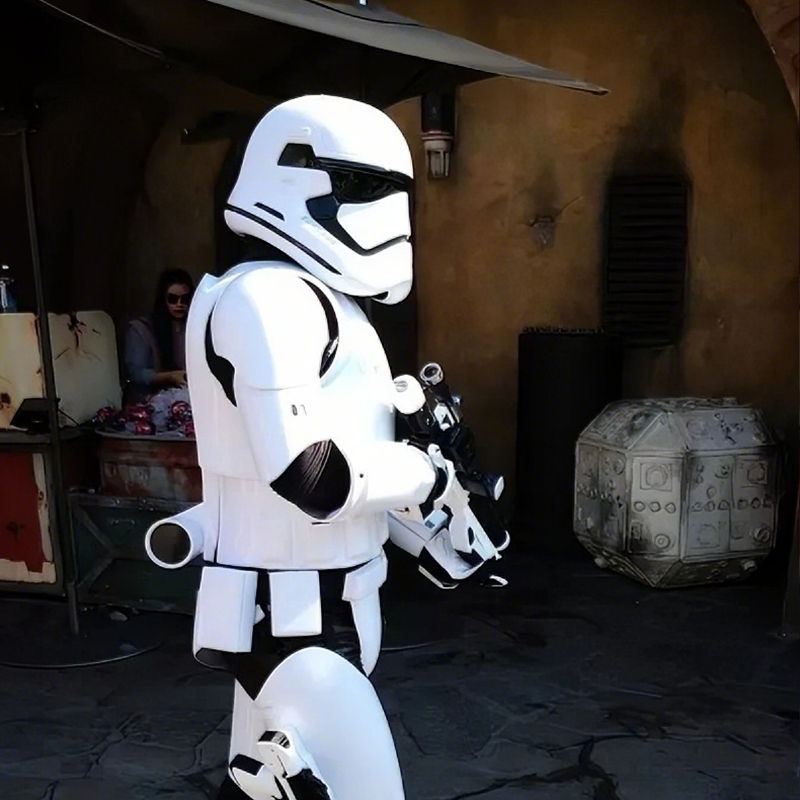
Disney California Adventure’s "Star Wars: Galactic Starcruiser" sets a benchmark for high-value scenes. By deeply integrating rear-projection AR with physical environments, it enables real-time interaction between visitors and virtual characters. The project innovatively designed dual story lines ("Light/Dark Factions") and uses AI to generate random dynamic tasks, significantly increasing visitors’ willingness to revisit. Its success depend on "technology serving IP": sub-millimeter-level motion capture ensures that interactive scenes like light saber battles and spaceship driving align perfectly with the "Star Wars" IP, effectively driving a substantial growth in the surrounding product sales.
Chimelong Ocean Kingdom’s beluga whale-themed projects in China offer immersive experiences for parent-child audiences through a combination of virtual and real interactions. For example, the Underwater Interactive Boat uses integrated real-scene and virtual imaging technology, allowing visitors to explore the ocean world on land. Meanwhile, the Beluga Whale Theater features constant-temperature venues and trainer collaboration to deliver human-whale interactive performances. These projects are popular among family audiences due to their strong interactivity and high safety, effectively enhancing visitor loyalty.
2. Shopping Malls/Commercial Complexes
The core demand for entertainment zones in shopping malls is "short-term attraction + rapid conversion." Modular animatronic equipment has become the optimal solution thanks to its flexible deployment and high cost-effectiveness. As a leading enterprise in Zigong’s simulation dinosaur industry, Star Robot enters commercial scenes with lightweight, interactive products. In the second half of 2024, Hangzhou Hubin Intime City introduced a "Mini Prehistoric Park" experience zone from Star Robot, including Animatronic Dinosaur, Animatronic T-Rex, Animatronic Triceratops, and Animatronic Ankylosaurus. Using a small space, it created an "immersive interactive scene." The zone adopted a "Spend to qualify" model but achieved a high foot traffic effect.
A shopping mall in Spain purchased our Customized Products—Robot Ankylosaur. Its novelty, uniqueness, and strong interactivity significantly increased the mall’s foot traffic and boosted surrounding consumption.

3. Haunted Houses/Escape Rooms
The competitive focus of horror entertainment scenes has shifted from "visual impact" to "multi-sensory immersion." During Halloween 2025, a high-end haunted house in Shibuya, Tokyo, introduced "Haunted House Props" animatronic equipment. Equipped with infrared sensors, the equipment can trigger immersive attack modes (roaring, movements) based on visitors’ actions, combined with full-scene decoration—quickly becoming Japan’s top haunted house choice.
Low-cost upgrade solutions are also feasible: a chain escape room in China adopted a combination of "voice-controlled blood packs + variable-frequency fans" with basic animatonic props, extending game time and increasing player satisfaction rates.
Key Decision-Making Factors
For decision-makers, animatronic technology is not "the more high-end, the better." Precise judgments must be made based on cost, target audience, and policies:
1. Cost Structure
Referring to mature industry models, the optimal cost allocation for animatronic projects is 40% for R&D, 35% for hardware procurement, and 25% for content development. For example, an 800-million-yuan project would allocate 320 million yuan to core R&D (e.g., AR interaction systems), 280 million yuan to hardware (simulation equipment, sensors), and 160 million yuan to IP content development. Such projects can achieve a stable ROI of over 12% in the first three years of operation, with top projects exceeding 50%. Small and medium-sized venues can adopt a "modular procurement + renting" model.
2. Target Audience
IAAPA data shows that the 25-35 age group accounts for the largest share of consumption in animatronic experience projects. They prefer technologies with "interactive participation + social sharing" features. Therefore, theme parks should focus on "multi-ending storylines" (e.g., Universal Studios Osaka’s Harry Potter project), shopping malls need to enhance "lightweight AR interactions," and haunted houses should emphasize "personalized thrilling experiences." For family audiences, the intensity of animatronic equipment should be controlled, and educational elements (e.g., animatronic dinosaurs with audio explanations) should be added.
3. Policies
Many countries and regions have launched subsidies for cultural tourism and technology integration:
Saudi Arabia increased the local employment wage subsidy for the tourism industry from 30% to 50%, covering 43 occupations including animatronic equipment operation and maintenance. Projects in Saudi Arabia can reduce labor costs through this policy.
China’s Ministry of Culture and Tourism provides special fund support for technology-integrated projects. Regions like Guangdong drive related industrial value-added through cultural tourism technology investment. Enterprises can reduce risks through a combination of "policy applications + own funds + strategic investment."
Cooperation Guidelines
Decision-makers in different scenarios can find suppliers based on their needs to improve cooperation efficiency:
Sichuan Star Robot Technology Co., Ltd
High-fidelity bionic models suitable for shopping malls, amusement parks, theme parks, airports, and entertainment venues.
Haptic animatronic equipment for escape rooms/haunted houses, supporting customized scary modes.
Hold global certifications including CE and ISO.